
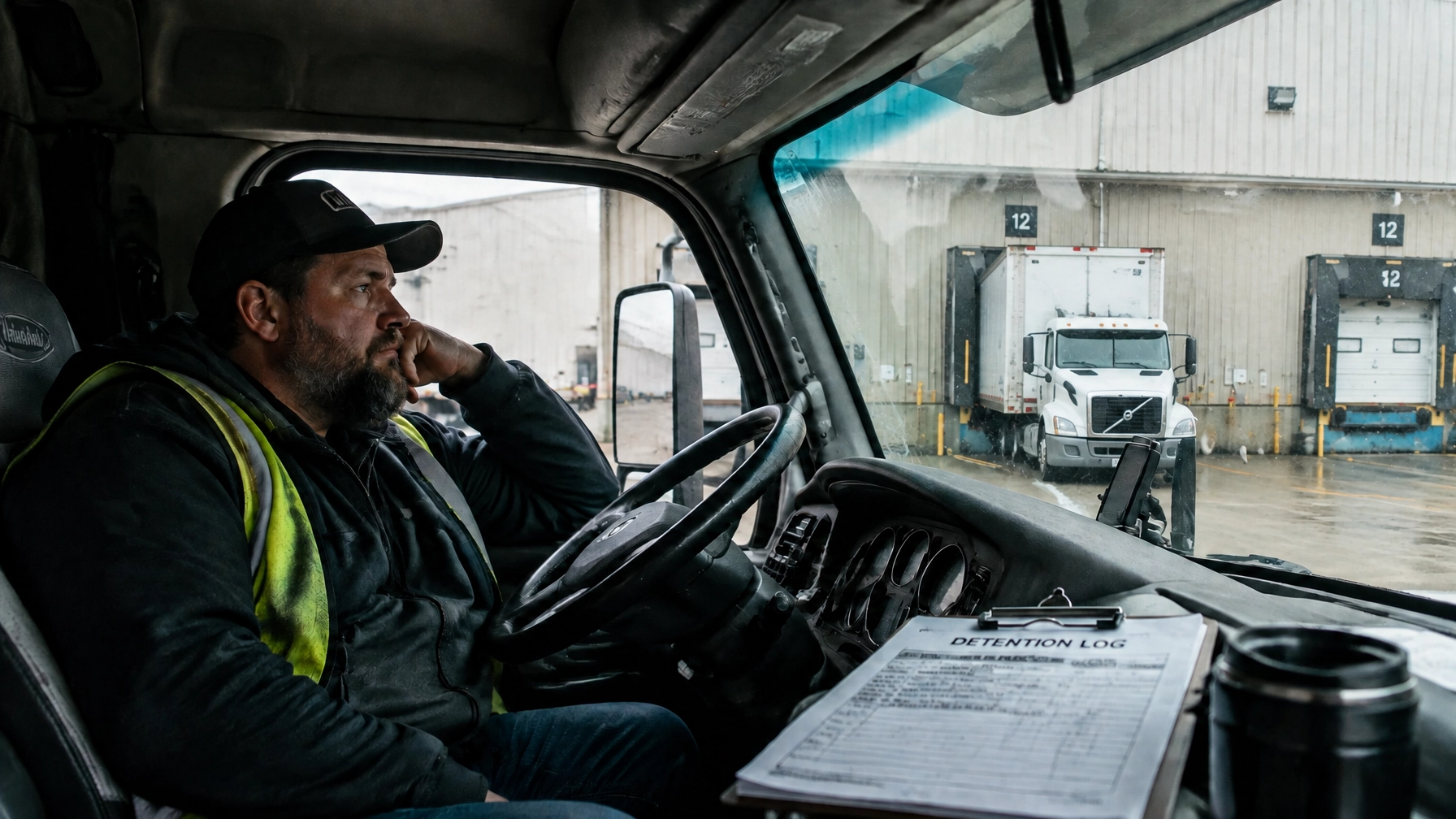
A truck can be fully loaded, properly dispatched, and still become an unexpected expense before it leaves the dock. When a driver waits beyond the agreed free time for loading or unloading, detention charges begin. For temperature-controlled freight, the financial and operational consequences can escalate quickly.
Detention management is a critical part of controlling transportation costs and keeping freight moving efficiently, safely, and cost-effectively.
At Fruition Logistics, we know that reliable transportation involves more than finding a truck. It requires appointment discipline, dock coordination, real-time communication, and active monitoring from pickup through delivery.
WHAT ARE DETENTION, DEMURRAGE, AND FREE TIME?
These terms are related, but they describe different charges and different points in the freight process.
Detention is the fee charged when a truck and driver are held at a shipper’s or consignee’s facility beyond the agreed free time. It is generally billed by the hour.
Demurrage usually applies to loaded ocean containers that remain inside a port, rail terminal, or container yard after the permitted free days expire. It is commonly billed by the container, per day.
In ocean and intermodal transportation, container detention, often called per diem, may also apply when a container remains outside the terminal longer than permitted before the empty equipment is returned.
The distinction is important:
- Truck detention: A truck, trailer, and driver are waiting at a facility.
- Demurrage: A loaded container is occupying terminal space beyond its free time.
- Container detention or per diem: Equipment remains outside the terminal beyond the allowed period.
- Dwell time: The total time a truck spends at a facility. Dwell time is a performance metric, not a charge, but it is the number that often leads to detention.
What is free time? It is the agreed period during which a carrier or terminal allows loading, unloading, or equipment use without an additional accessorial charge. In many truckload contracts, free time is approximately two hours, but the actual allowance depends on the rate confirmation, carrier agreement, equipment, facility, and shipment requirements.
Never assume that every load has the same free-time terms. Confirm them before the truck arrives.
WHY DETENTION QUIETLY DAMAGES YOUR FREIGHT BUDGET
Detention is easy to underestimate because it often appears as a small accessorial charge after the shipment has been delivered. The true cost is much larger.
Industry reporting commonly places truck detention rates in the range of $50 to $100 per hour after free time, with specialized equipment such as reefers potentially reaching approximately $125 per hour, depending on the agreement.
Consider a simple example:
- A refrigerated truck arrives at 8:00 a.m.
- The shipment has two hours of free time.
- Loading does not begin until 10:45 a.m.
- The driver is released at 11:30 a.m.
- The carrier bills detention for the time beyond the free period.
At an illustrative rate of $100 per hour, that delay can create more than $100 in additional cost. If the same facility generates detention on multiple loads each week, the annual impact becomes significant.
The American Transportation Research Institute reported that drivers experienced detention at 39.3% of stops in 2023, contributing to an estimated $15.1 billion in industry-wide costs. The impact includes direct expenses, lost productivity, and reduced asset utilization.
Why does unpaid detention matter even when a carrier does not successfully collect the charge? Because the carrier still absorbs the lost time. A driver who waits at one facility may miss the next pickup, lose available driving hours, or finish the day without another revenue-producing load.
That cost eventually influences freight rates, carrier availability, and service decisions. A facility with chronic delays may receive fewer capacity options or higher quotes, even when no separate “difficult facility” fee appears on the invoice.
WHY TEMPERATURE-CONTROLLED FREIGHT HAS MORE AT RISK
Detention is problematic for all freight, but it is especially serious for refrigerated and temperature-sensitive shipments.
A reefer unit is not simply a dry van with a cooling setting. The equipment must maintain the required temperature range while the truck is waiting, loading, unloading, or traveling. Extended dwell time increases exposure to several risks:
- Reefer fuel consumption and engine hours continue while the truck waits.
- The refrigeration unit must work longer to maintain the set point.
- Repeated door openings can introduce warmer air into the trailer.
- A delay can compress the remaining delivery window.
- Temperature deviations may create quality concerns, rejected freight, claims, or spoilage exposure.
- A delayed driver may miss the consignee’s receiving window at the next stop.

What happens when a product is technically still within range but arrives late? The business may still face missed production schedules, retail appointment issues, reduced shelf life, or additional storage costs.
Temperature control must be maintained from loading to delivery. Fruition Logistics coordinates temperature-controlled FTL and LTL shipping, real-time tracking, dedicated dispatch support, and shipment monitoring to help protect both product quality and delivery performance. Learn more about our temperature-controlled freight services.
FIVE PRACTICAL WAYS TO REDUCE DETENTION COSTS
1. Confirm the Appointment, Free Time, and Facility Rules Before Dispatch
From the carrier perspective, detention prevention starts before the truck moves. Confirm the appointment time, free-time allowance, check-in procedure, dock hours, lumper process, temperature requirements, and detention policy before dispatching the load.
Why does this matter? Because avoidable confusion at the facility often becomes unpaid waiting time for the carrier. If the rate confirmation, facility instructions, or free-time terms are unclear, resolve those questions before the driver is en route.
This is especially important for refrigerated freight, where set point requirements, trailer washout expectations, product temperature rules, and receiving procedures can affect how quickly the truck is worked.
2. Arrive Ready With the Correct Equipment, Pre-Trip, and Paperwork
A carrier should arrive on time and fully prepared when the appointment window begins. That means sending the correct equipment, ensuring the reefer has been properly pre-tripped, confirming the unit is operating at the required set point, and making sure the driver has complete and accurate paperwork.
The objective is simple: remove every preventable reason a facility could delay loading or unloading.
For reefer freight, readiness is imperative. If a driver arrives with the wrong trailer condition, incomplete documents, or an unresolved temperature issue, the facility may refuse to load, restart the process, or push the truck back in line.
3. Check In Promptly and Document Every Timestamp
Detention disputes are often documentation disputes. The driver and carrier should record every key timestamp from the moment the truck reaches the facility.
A complete record should include:
- The scheduled appointment time.
- The actual arrival time at the facility.
- The check-in time.
- The dock assignment time.
- The loading or unloading start time.
- The completion time.
- The departure time.
- Any instructions, delays, or reschedules communicated by the facility, broker, or shipper.
Accurate records matter because carriers should not absorb delays caused by a facility. When detention is legitimate, precise documentation supports fair detention payment and reduces unnecessary disputes.
4. Escalate Delays Immediately and Get Instructions in Writing
What should a driver or carrier do when the dock falls behind, the appointment is missed due to facility congestion, or loading has not started within the free-time window?
Communicate immediately with dispatch, the broker, and the facility.
Early escalation protects the shipment and creates a documented record that the delay did not originate with the carrier. It also gives all parties an opportunity to request written instructions, confirm whether the truck should continue waiting, or obtain a rescheduled appointment when necessary.
At Fruition Logistics, our specialists actively monitor shipments and provide updates throughout the transportation process. We help coordinate communication quickly so problems are addressed while the load is still moving, not after the detention invoice appears.
5. Submit Detention Paperwork Promptly and Plan the Next Load Realistically
Once a delay occurs, the carrier should submit accurate detention documentation as soon as possible, including signed bills, in and out times, check-in records, and any written messages that confirm the facility-caused delay.
Prompt submission improves the likelihood of fair review and payment. Just as important, carriers should build future schedules around known dwell times at repeat facilities instead of accepting impossible reload plans that assume every dock will turn a truck quickly.
A realistic plan protects driver hours, equipment utilization, and service performance on the next load. When a facility consistently creates delays, that pattern should inform appointment strategy, pricing, and load planning. Carriers should not be expected to absorb recurring facility inefficiency as a normal operating cost.
This is particularly important for refrigerated, oversized, overweight, and time-sensitive freight. Complex shipments require disciplined planning, immediate communication, and documentation strong enough to support fair compensation when delays occur.
HOW FRUITION LOGISTICS HELPS PROTECT YOUR BUDGET
Fruition Logistics coordinates the entire shipping process, including pickup and delivery scheduling, carrier communication, monitoring, and issue resolution. Our team supports temperature-controlled FTL and LTL, dry van transportation, oversized and overweight freight, and specialized shipping across the United States, Canada, and Mexico.

We understand that the lowest linehaul quote is not always the lowest total transportation cost. A lower rate can quickly lose its advantage when a shipment experiences repeated detention, missed appointments, temperature exposure, or delivery interruptions.
Our objective is to optimize the complete movement:
- The right equipment.
- The right appointment.
- The right carrier.
- The right communication.
- The right documentation.
- The right response when conditions change.
Our full range of logistics services is designed to give your business one reliable point of coordination. Whether you need one urgent shipment or recurring transportation support, our team works to deliver the visibility and peace of mind your supply chain requires.
THE BOTTOM LINE
Detention is not merely an accessorial charge. It is the visible result of lost capacity, inefficient dock operations, missed appointments, excess reefer utilization, and avoidable communication gaps.
Free time must be clearly defined. Appointments must be realistic. Freight and documentation must be ready before arrival. Every timestamp must be recorded. When delays occur, the parties must communicate quickly and resolve the issue fairly.
For temperature-controlled freight, these practices are imperative because every additional hour can increase both cost and product risk.
At Fruition Logistics, we manage the details that keep freight moving. Our team combines unmatched execution, active shipment monitoring, and personalized service to help you reduce detention exposure and protect your freight budget. Request a customized quote to discuss your next shipment.